Quote of the day!
Je Suis Charlie!
KEEP YOUR POWDER DRY!!!!
Showing posts with label Space Weather. Show all posts
Wednesday, October 22, 2014
Solar Eclipse on Thursday, October 23rd.
Solar activity is surging on the eve of Thursday's solar eclipse. Giant sunspot AR2192 is crackling with M- and X-class solar flares as the Moon approaches the sun for a partial eclipse that will be visible across almost all of North America on Oct. 23rd. The eclipse will be particularly beautiful in the Central Time Zone where maximum coverage occurs at sunset.
SOLAR FLARE ALERT: Giant sunspot AR2192 is poised to erupt again.
For more information on AR2192 or other solar flares head on to SpaceWeather.com.
Tuesday, October 7, 2014
Total Lunar Eclipse
![]() |
| During the eclipse, the Moon will look like this. |
TOTAL ECLIPSE OF THE MOON: The Moon is about to pass through the shadow of Earth, producing a colorful lunar eclipse. Sky watchers in the Americas, Australia, Pacific islands and parts of Asia can expect to see the full Moon turn beautiful shades of red and turquoise for nearly an hour on Wednesday morning, Oct. 8th.
Sky watchers in the Americas, Australia and most of Asia can see the full Moon turn red as it passes through the sunset-colored shadow of Earth: visibility map. The show begins at approximately 9:15 UT (2:15 a.m. PDT) when the Moon makes first contact with the core of Earth's shadow. Totality, when the Moon is fully shadowed, begins at 10:25 UT (3:25 a.m. PDT) and lasts for nearly an hour.
The hue of the lunar disk may seem puzzling to some readers. Shadows are supposed to be black, yet the shadowed Moon is mostly bright red.
For more information go to SpaceWeather.com
Monday, April 14, 2014
Blood Moon Rising
TOTAL LUNAR ECLIPSE: On Tuesday morning, April 15th, the full Moon will pass through the shadow of Earth, producing a colorful lunar eclipse. Although the mainstream media is calling this a "blood moon," the color is more likely to be bright orange. At the moment, Earth's stratosphere is not dusty enough produce a shadow with the deep red hues of blood. Whatever color it turns out to be, the eclipse will be visible from North and South America, Australia and New Zealand.
Creedence Clearwater Revival: Bad Moon Rising
Click here if the video fails to load.
Saturday, November 2, 2013
Solar Eclipse
Early Sunday morning, Nov. 3rd, sky watchers along the east coast of North America might notice something missing--a piece of the sun. A partial solar eclipse will be underway at sunrise. In the United States, visibility stretches all the way from Maine to the southern tip of Florida. Later, the Moon will cover the entire sun producing a total eclipse over parts of the Atlantic Ocean and Africa.
Early Sunday morning, sky watchers along the east coast of North America might notice something missing--a piece of the sun. A partial eclipse will be underway at sunrise. Dawn will look something like this:
As much as 54% of the sun will be covered by the New Moon; the size of the bite depends on location. To see it, look east between about 6:30 am and 7 am EST. Although low-hanging clouds might dim the sun to naked-eye visibility, safe solar filters are strongly recommended. Aluminized Mylar and #14 welder's glass are popular choices. Also, don't forget that Daylight Time changes to Standard Time at 2 am on Nov. 3rd. Set your clocks back one hour before the eclipse begins!
Sunrise is just the beginning. Next, the eclipse races across the Atlantic toward Africa where coverage reaches 100%. Inside a narrow path of totality, sky watchers can see the sun's ghostly corona spring out from behind the Moon. The dark core of the Moon's shadow will touch parts of several African nations including Gabon, the Congo, Uganda, Kenya, Ethiopia and Somalia. In those places, totality can be seen. Meanwhile, a partial eclipse will be visible across the entire continent. You can view the visibility map here.
You can find out more about the upcoming Solar Eclipse at SpaceWeather.
Sunday, October 20, 2013
ORIONID METEOR SHOWER
Earth is passing through a stream of debris from Halley's Comet, source of the annual Orionid meteor shower. Forecasters expect the shower to peak on Oct. 21st with approximately 20 meteors per hour. Bright moonlight will reduce visibility, however. The best time to look is during the hours before local sunrise when the shower's radiant in the constellation Orion is high in the sky.
Lunar interference will be a problem during the peak. All but the brightest Orionids will be wiped out by glare from the waning full Moon. Fortunately there are some bright ones. NASA's All Sky Fireball Network captured this Orionid fireball shining through the moonlight over Georgia on the morning of Oct. 20th:
Check with SpaceWeather.com for more information.
Monday, September 30, 2013
What Was It?
From Space Weather
MAGNIFICENT ERUPTION: Breaking the quiet in spectacular fashion, a magnetic filament erupted from the sun's northern hemisphere at approximately 2145 UT on Sept. 29th. NASA's Solar Dynamics Observatory recorded the blast:
Another movie from the Solar Dynamics Observatory zooms in to show the filament ripping through the sun's atmosphere and leaving behind a "canyon of fire." The glowing "canyon" traces the channel where magnetic forces held the filament aloft before the explosion.
This event also hurled a magnificent CME into space: movie (Credit: SOHO). The magnetized cloud, which left the sun traveling approximately 900 km/s (2 million mph), was not aimed toward Earth. Nevertheless, our planet's magnetosphere might receive a glancing blow on Oct. 2-3. Polar geomagnetic storms and auroras are possible when the CME arrives.
COMET ISON APPROACHES MARS: In two months, Comet ISON will make a spectacular flyby of the sun. First, though, it has to fly by Mars. The sungrazing comet is approaching the Red Planet for a 0.07 AU close encounter on October 1st. Mars satellites and rovers will have a close-up view. A video from NASA details the encounter.
Amateur astronomers on Earth can watch, too. Using a remotely controlled 14-inch telescope in New Mexico, Rolando Ligustri photographed ISON approaching Mars on September 28th:
At closest approach on October 1st, Mars and Comet ISON will be approximately 2o apart. While Mars is visible to the unaided eye (it shines almost as brightly as a first-magnitude star), ISON is definitely not. The comet is still far from the sun and, as it crosses the orbit of Mars, it has not yet warmed enough to reach naked-eye visibility. Reports of the comet's brightness vary from 12th to 14th magnitude, which means a mid-sized backyard telescope is required to see it.
Mars and ISON rise together in the eastern sky a couple of hours before the sun. Amateur astronomers, if you have a GOTO telescope, enter these coordinates. Visually, Mars will be easy to find on the mornings of closest approach, not only because the planet is relatively bright, but also because the crescent Moon will be passing right by it.
OHIO FIREBALL: On Sept. 27th, a meteor exploded in the skies above the US Midwest. Witnesses report shadows cast upon the ground, unusual sounds, and a swirling contrail marking the aftermath of the blast. "It was the most brilliant fireball that I have ever seen!" reports Angela McClain, who sends this picture from Faith Ranch in Jewett, Ohio:
"The entire landscape lit up," she continues. "I spun around and there it was, a huge, bright green light, streaking across the sky. Even when it was gone, there was still a bright line in the sky about 20 seconds later. We were all stunned."
A NASA all-sky camera in Hiram, Ohio, also recorded the fireball: movie.
"This was a very bright event," says Bill Cooke of NASA's Meteoroid Environment Office. "Flares saturated our meteor cameras, and made determination of the end point (the terminus of the fireball's flight through the atmosphere) virtually impossible. Judging from the brightness, we are dealing with a meter class object."
Data from multiple cameras shows that the meteoroid hit Earth's atmosphere traveling 51 km/s (114,000 mph) and passed almost directly over Columbus, Ohio. Cooke has prepared a preliminary map of the ground track. According to the American Meteor Society, the fireball was visible from at least 14 US states.
KEEP WATCHING THE SKIES!!!!!
Sunday, August 11, 2013
Perseid Meteor Shower Intensifies
PERSEID METEOR SHOWER: The Perseid meteor shower is intensifying as Earth moves deeper into the debris stream of parent comet 109P/Swift-Tuttle. International observers are reporting as many as 30 Perseids per hour from dark sky sites, a rate which could triple on August 12-13 when the shower peaks.
You can listen to the Perseid meteor shower on Space Weather Radio, which is monitoring signals from the USAF Space Surveillance Radar. Every Perseid that flies over the radar makes an audible ping. Hear the echoes here.
Friday, July 5, 2013
Big Sunspot Turns Towards Earth
From Space Weather
BIG SUNSPOT: One of the biggest sunspot groups of the current solar cycle has emerged in the sun's southern hemisphere. AR1785 has an unstable magnetic field that harbors energy for strong solar flares, and it is turning toward Earth.
These sunspots are a sign that the sun's southern hemisphere is waking up. For most of the current solar cycle, the northern half of the sun has dominated sunspot counts and flare production. The south has been lagging behind--until now. June brought a surge in southern sunspots, and the trend is continuing in July. This "southern awakening" could herald a double-peaked Solar Maximum due in late 2013-early 2014.
The largest dark cores in sunspot complex AR1785-1787 are as wide as Earth, making the ensemble an easy target for backyard solar telescopes. Amateur astronomers are encouraged to monitor developments, as NOAA forecasters estimate a 40% chance of M-flares during the next 24 hours
Check http://spaceweather.com for more information and updates.
Wednesday, May 22, 2013
CME And Solar Radiation Storm
From SpaceWeather:
SIGNIFICANT EXPLOSION: A solar radiation storm is in progress on May 22nd following an M5-class solar flare on the sun's western limb. The explosion not only accelerated a hailstorm of protons toward our planet, but also produced a magnificent CME, which might deliver a glancing blow to Earth's magnetic field in the days ahead.
Although the explosion was not Earth-directed, we cannot yet rule out the possibility that the CME could deliver a glancing blow to Earth in the days ahead.
Tuesday, May 14, 2013
Strong Solar Activity
Solar activity is high. During a 24 hour period straddling May 13th and 14th, the sun unleashed three X-class solar flares. These are the strongest flares of the year so far, and they signal a significant increase in solar activity. The source of the flares, a large sunspot on the sun's eastern limb, appears poised to erupt again as it turns toward Earth.
Check SpaceWeather.com for more updates.
Friday, January 11, 2013
Space Weather Alert
ACTIVE SUNSPOT: One of the biggest sunspots of the current solar cycle is now turning toward Earth. Named AR1654, the active region is crackling with medium-sized (M-class) flares and could be poised to break the recent spell of calm space weather around our planet.
INCREASING CHANCE OF FLARES: Big sunspot AR1654 is growing more active. It is now crackling with M-class solar flares, such as this one recorded by NASA's Solar Dynamics Observatory this morning at 09:11 UT:
AR1654 is getting bigger as it turns toward Earth. Not only is the chance of flares increasing, but also the chance of an Earth-directed eruption.This could be the sunspot that breaks the recent lengthy spell of calm space weather around our planet.
For more information visit SpaceWeather.com
Thursday, December 13, 2012
Geminid Meteor Shower Is Underway!
From SpaceWeather:
GEMINID METEOR SHOWER: Earth is passing through a stream of debris from "rock comet" 3200 Phaethon, source of the annual Geminid meteor shower. Around the world, observers are counting as many as 60 shooting stars per hour, a number which could increase sharply as the shower peaks on the night of Dec. 13-14. Wherever you live, the best time to look is during the dark hours between local midnight and sunrise.Oh My G-d! The sky is falling! Call Al Gore! This must be caused by Global Warming! It's not yet 12/21!!!
Now to calm the fears of the doomsday worriers. The Geminids are an annual event.
The Geminids are a meteor shower caused by the object 3200 Phaethon, which is thought to be a Palladian asteroid with a "rock comet" orbit. This would make the Geminids, together with the Quadrantids, the only major meteor showers not originating from a comet. The meteors from this shower are slow moving, can be seen in December and usually peak around the 13th - 14th of the month, with the date of highest intensity being the morning of the 14th. The shower is thought to be intensifying every year and recent showers have seen 120–160 meteors per hour under optimal conditions, generally around 02:00 to 03:00 local time. Geminids were first observed in 1862, much more recently than other showers such as the Perseids (36 AD) and Leonids (902 AD).Which means it happens every year about this time. It is a beautiful sight if the weather allows and a great reason to take the kids outside for a view.
I hope you will have good seeing and a clear sky. The best thing about viewing the Geminids here in the Northern Hemisphere is the Hot Cocoa and cookies you get afterwards.
Saturday, November 10, 2012
TAURID METEOR SHOWER
From SpaceWeather:
TAURID METEOR SHOWER: Earth is passing through a stream of gravelly debris from Comet Encke, source of the annual Taurid meteor shower. Because the debris stream is not very congested, Taurid meteor rates are low, no more than 5 per hour. The special thing about Taurids is that they tend to be fireballs. Check http://spaceweather.com for the latest videos and images of the display, which is expected to peak around Nov. 12th.
TOTAL ECLIPSE OF THE SUN: Scientists and sky watchers are converging on the northeast coast of Australia, near the Great Barrier Reef, for a total eclipse of the sun on Nov. 13/14. For researchers, the brief minutes of totality open a window into some of the deepest mysteries of solar physics.
The sky this weekend will be interesting to say the least.
Saturday, August 11, 2012
Perseid Meteor Shower
From Space Weather
Earth is entering a stream of debris from Comet Swift-Tuttle, source of the annual Perseid meteor shower. Worldwide observers are now reporting more than 30 Perseids per hour, a number that could triple during the weekend when Earth reaches the heart of the debris zone. Forecasters recommend looking during the dark hours before dawn, especially Sunday morning, August 12th, when activity is expected to be highest.
Enjoy the skies tonight!
Thursday, July 12, 2012
Earth-Directed X-Flare And CME
WARNING!!!!!
Big sunspot AR1520 erupted on July 12th around 16:53 UT, producing an X-class solar flare and hurling a CME directly toward Earth. Forecasters expect the cloud to arrive on July 14th. Its impact could spark moderate to severe geomagnetic storms, allowing auroras to be seen at lower latitudes than usual.
For one thing, it hurled a coronal mass ejection (CME) directly toward our planet. According to a forecast track prepared by analysts at the Goddard Space Weather Lab, the CME will hit Earth on July 14th around 10:20 UT (+/- 7 hours) and could spark strong geomagnetic storms. Sky watchers should be alert for auroras this weekend.
The explosion also strobed Earth with a pulse of extreme UV radiation, shown here in an image captured by NASA's Solar Dynamics Observatory:
The UV pulse partially ionized Earth's upper atmosphere, disturbing the normal propagation of radio signals around the planet. Monitoring stations in Norway and Ireland recorded the sudden ionospheric disturbance.
Finally, solar protons accelerated by the blast are swarming around Earth. The radiation storm, in progress, ranks "S1" on NOAA space weather scales, which means it poses no serious threat to satellites or astronauts. This could change if the storm continues to intensify.
For more information check with Space Weather.
Big sunspot AR1520 erupted on July 12th around 16:53 UT, producing an X-class solar flare and hurling a CME directly toward Earth. Forecasters expect the cloud to arrive on July 14th. Its impact could spark moderate to severe geomagnetic storms, allowing auroras to be seen at lower latitudes than usual.
For one thing, it hurled a coronal mass ejection (CME) directly toward our planet. According to a forecast track prepared by analysts at the Goddard Space Weather Lab, the CME will hit Earth on July 14th around 10:20 UT (+/- 7 hours) and could spark strong geomagnetic storms. Sky watchers should be alert for auroras this weekend.
The explosion also strobed Earth with a pulse of extreme UV radiation, shown here in an image captured by NASA's Solar Dynamics Observatory:
Finally, solar protons accelerated by the blast are swarming around Earth. The radiation storm, in progress, ranks "S1" on NOAA space weather scales, which means it poses no serious threat to satellites or astronauts. This could change if the storm continues to intensify.
For more information check with Space Weather.
Thursday, July 5, 2012
High Solar Activity
From Space Weather:
Sunspot AR1515 has grown into a behemoth more than 10 times wider than Earth. The active region is crackling with M-class solar flares and seems poised to produce even stronger X-flares in the days ahead. At least one CME is en route to Earth, and ham radio operators are reporting shortwave solar radio bursts roaring from the loudspeakers of their receivers.Remember these are just warnings. The sky isn't falling. Just a reminder to take precautions.
Friday, June 15, 2012
Get Ready, Here It Comes.
DOUBLE CME: Active sunspot AR1504 is facing Earth and hurling coronal mass ejections (CMEs) in our direction. A fast-moving CME that left the sun on June 14th is expected to scoop up another CME already en route and deliver a double-blow to Earth's magnetic field on June 16th. Weak-to-moderate geomagnetic storms are possible when the clouds arrive.
According to the forecast track prepared by analysts at the Goddard Space Weather Lab, the CMEs will also hit Venus on June 15th and Mars on June 19th. Because Venus and Mars do not have global magnetic fields to protect them, both of those planets will probably lose tiny amounts of atmosphere when the CMEs strike.
Here on Earth, the impact is likely to trigger a geomagnetic storm around the poles. High-latitude sky watchers should be alert for auroras on June 16th.
To learn more and track this CME visit SpaceWeather
Tuesday, May 29, 2012
Small Asteroid Buzzes Earth Today
Newly-discovered asteroid 2012 KT42 is flying past Earth today (May 29th) only ~14,000 km above the planet's surface. This means 2012 KT42 will actually fly inside the Clark Belt of geosynchronous satellites. The 3- to 10-meter wide asteroid ranks # 6 on the top 20 list of closest-approachers to Earth. According to the asteroid's orbit, there is no danger of a collision. Even if it did hit, this space rock is too small to cause significant damage. It would likely disintegrate almost entirely in the atmosphere, peppering the ground below with relatively small meteorites.
Find out more and see the latest pictures at Space Weather.
Thursday, May 17, 2012
The Afternoon Sky Will Darken
The West Coast of the United States (and a good part of the Pacific Ocean) should get ready for one of the wildest journeys they can experience.
This comes right off the Super Moon Event of earlier this month. This spectacular event will out do even that Magnificent Spectacle.
From SpaceWeather:
This comes right off the Super Moon Event of earlier this month. This spectacular event will out do even that Magnificent Spectacle.
From SpaceWeather:
On Sunday, May 20th, the Moon will pass in front of the Sun, producing an annular solar eclipse visible across the Pacific side of Earth. The path of annularity, where the sun will appear to be a "ring of fire" stretches from China and Japan to the middle of North America:Remember to never look directly into an eclipse. Magnified sunlight can cause serious eye damage even during an eclipse.
SOLAR ECLIPSE THIS WEEKEND: On Sunday, May 20th, the Moon will pass in front of the Sun, producing an annular solar eclipse visible across the Pacific side of Earth. The path of annularity, where the sun will appear to be a "ring of fire" stretches from China and Japan to the middle of North America
An animated eclipse map prepared by Larry Koehn of ShadowandSubstance.com shows the best times to look. In the United States, the eclipse begins at 5:30 pm PDT and last for two hours. Maximum coverage is around 6:30 pm PDT.
Because this is not a total eclipse, some portion of the sun will always be exposed. To prevent eye damage, use eclipse glasses, a safely-filtered telescope, or a solar projector to observe the eclipse. You can make a handy solar projector by criss-crossing your fingers waffle-style. Rays of light beaming through the gaps will have the same shape as the eclipsed sun. Or look on the ground beneath leafy trees for crescent-shaped sunbeams and rings of light
Full Story
And Enjoy The Show!!!!
Thursday, May 10, 2012
Big Sunspot Crackling With Flares And Radio Bursts
Heads Up People. The Sun, our Star is acting up again.
From SpaceWeather:
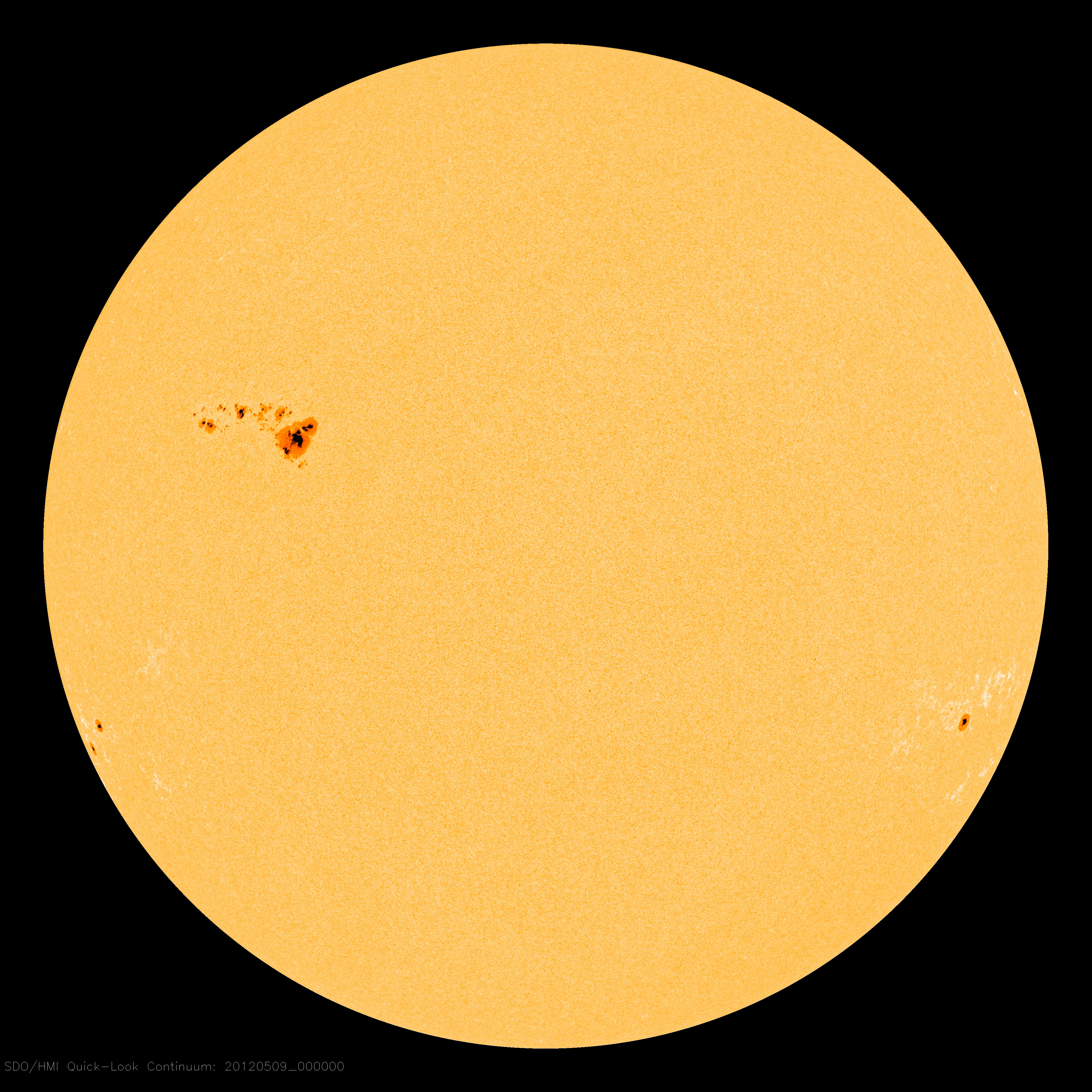
Huge sunspot AR1476 is crackling with M-class solar flares and appears to be on the verge of producing something even stronger. The sunspot's 'beta-gamma-delta' magnetic field harbors energy for X-class flares, the most powerful kind. Radio operators are recording strong bursts of shortwave static from the sunspot as it turns toward Earth.Expect atmospherics to act up for a while, the Northern Lights should be spectacular for those who can view them. But be warned that radio signals will be experiencing problems for the next few days.
Earlier today, amateur astronomer Thomas Ashcraft of New Mexico detected strong shortwave radio bursts coming from the sunspot. Click to hear the "solar static" that roared out of his loudspeaker.
"The strongest burst so far occured around 1631 UT on May 9th," reports Ashcraft. "I am observing at 28 MHz and 21.1 MHz. As I send this note I am hearing more bursting, indicating powerful magnetic dynamism within active region 1476."
Solar radio bursts are caused by plasma instabilities that ripple through the sun's atmosphere in the aftermath of powerful flares. With AR1476 poised for more eruptions, this 'radio activity' is likely to continue for days.
Subscribe to:
Posts (Atom)