Showing posts with label Solar Flare. Show all posts

Monday, September 30, 2013

What Was It?

From Space Weather

MAGNIFICENT ERUPTION: Breaking the quiet in spectacular fashion, a magnetic filament erupted from the sun's northern hemisphere at approximately 2145 UT on Sept. 29th. NASA's Solar Dynamics Observatory recorded the blast: 


Another movie from the Solar Dynamics Observatory zooms in to show the filament ripping through the sun's atmosphere and leaving behind a "canyon of fire." The glowing "canyon" traces the channel where magnetic forces held the filament aloft before the explosion.

This event also hurled a magnificent CME into space: movie (Credit: SOHO). The magnetized cloud, which left the sun traveling approximately 900 km/s (2 million mph), was not aimed toward Earth. Nevertheless, our planet's magnetosphere might receive a glancing blow on Oct. 2-3. Polar geomagnetic storms and auroras are possible when the CME arrives.

COMET ISON APPROACHES MARS: In two months, Comet ISON will make a spectacular flyby of the sun. First, though, it has to fly by Mars. The sungrazing comet is approaching the Red Planet for a 0.07 AU close encounter on October 1st. Mars satellites and rovers will have a close-up view. A video from NASA details the encounter.

Amateur astronomers on Earth can watch, too. Using a remotely controlled 14-inch telescope in New Mexico, Rolando Ligustri photographed ISON approaching Mars on September 28th:


At closest approach on October 1st, Mars and Comet ISON will be approximately 2o apart. While Mars is visible to the unaided eye (it shines almost as brightly as a first-magnitude star), ISON is definitely not. The comet is still far from the sun and, as it crosses the orbit of Mars, it has not yet warmed enough to reach naked-eye visibility. Reports of the comet's brightness vary from 12th to 14th magnitude, which means a mid-sized backyard telescope is required to see it.

Mars and ISON rise together in the eastern sky a couple of hours before the sun. Amateur astronomers, if you have a GOTO telescope, enter these coordinates. Visually, Mars will be easy to find on the mornings of closest approach, not only because the planet is relatively bright, but also because the crescent Moon will be passing right by it.

OHIO FIREBALL: On Sept. 27th, a meteor exploded in the skies above the US Midwest. Witnesses report shadows cast upon the ground, unusual sounds, and a swirling contrail marking the aftermath of the blast. "It was the most brilliant fireball that I have ever seen!" reports Angela McClain, who sends this picture from Faith Ranch in Jewett, Ohio:


"The entire landscape lit up," she continues. "I spun around and there it was, a huge, bright green light, streaking across the sky. Even when it was gone, there was still a bright line in the sky about 20 seconds later. We were all stunned."

A NASA all-sky camera in Hiram, Ohio, also recorded the fireball: movie.

"This was a very bright event," says Bill Cooke of NASA's Meteoroid Environment Office. "Flares saturated our meteor cameras, and made determination of the end point (the terminus of the fireball's flight through the atmosphere) virtually impossible. Judging from the brightness, we are dealing with a meter class object."

Data from multiple cameras shows that the meteoroid hit Earth's atmosphere traveling 51 km/s (114,000 mph) and passed almost directly over Columbus, Ohio. Cooke has prepared a preliminary map of the ground track. According to the American Meteor Society, the fireball was visible from at least 14 US states.

KEEP WATCHING THE SKIES!!!!!

Tuesday, May 14, 2013

Strong Solar Activity


Solar activity is high.  During a 24 hour period straddling May 13th and 14th, the sun unleashed three X-class solar flares.  These are the strongest flares of the year so far, and they signal a significant increase in solar activity.  The source of the flares, a large sunspot on the sun's eastern limb, appears poised to erupt again as it turns toward Earth.

Check SpaceWeather.com for more updates.

Friday, January 11, 2013

Space Weather Alert


ACTIVE SUNSPOT One of the biggest sunspots of the current solar cycle is now turning toward Earth. Named AR1654, the active region is crackling with medium-sized (M-class) flares and could be poised to break the recent spell of calm space weather around our planet.

INCREASING CHANCE OF FLARES: Big sunspot AR1654 is growing more active. It is now crackling with M-class solar flares, such as this one recorded by NASA's Solar Dynamics Observatory this morning at 09:11 UT:


AR1654 is getting bigger as it turns toward Earth.  Not only is the chance of flares increasing, but also the chance of an Earth-directed eruption.This could be the sunspot that breaks the recent lengthy spell of calm space weather around our planet.

For more information visit SpaceWeather.com

Thursday, July 12, 2012

Earth-Directed X-Flare And CME

WARNING!!!!!

Big sunspot AR1520 erupted on July 12th around 16:53 UT, producing an X-class solar flare and hurling a CME directly toward Earth.  Forecasters expect the cloud to arrive on July 14th.  Its impact could spark moderate to severe geomagnetic storms, allowing auroras to be seen at lower latitudes than usual.


For one thing, it hurled a coronal mass ejection (CME) directly toward our planet. According to a forecast track prepared by analysts at the Goddard Space Weather Lab, the CME will hit Earth on July 14th around 10:20 UT (+/- 7 hours) and could spark strong geomagnetic storms. Sky watchers should be alert for auroras this weekend.

The explosion also strobed Earth with a pulse of extreme UV radiation, shown here in an image captured by NASA's Solar Dynamics Observatory:


The UV pulse partially ionized Earth's upper atmosphere, disturbing the normal propagation of radio signals around the planet. Monitoring stations in Norway and Ireland recorded the sudden ionospheric disturbance.

Finally, solar protons accelerated by the blast are swarming around Earth. The radiation storm, in progress, ranks "S1" on NOAA space weather scales, which means it poses no serious threat to satellites or astronauts. This could change if the storm continues to intensify.

For more information check with Space Weather.

Thursday, July 5, 2012

High Solar Activity


From Space Weather:
Sunspot AR1515 has grown into a behemoth more than 10 times wider than Earth. The active region is crackling with M-class solar flares and seems poised to produce even stronger X-flares in the days ahead. At least one CME is en route to Earth, and ham radio operators are reporting shortwave solar radio bursts roaring from the loudspeakers of their receivers.
Remember these are just warnings. The sky isn't falling.  Just a reminder to take precautions.

Thursday, May 10, 2012

Big Sunspot Crackling With Flares And Radio Bursts


Heads Up People.  The Sun, our Star is acting up again.

From SpaceWeather:
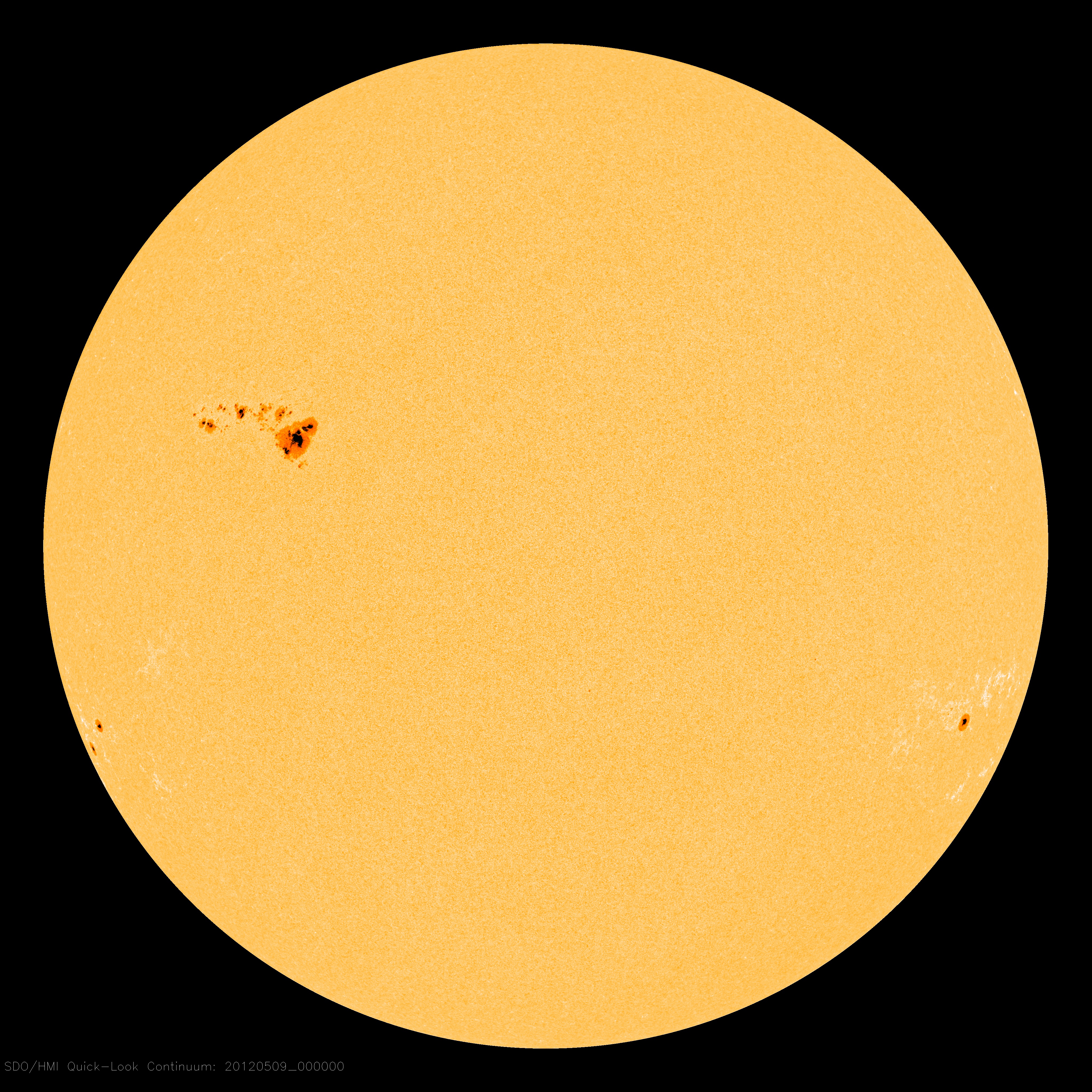
Huge sunspot AR1476 is crackling with M-class solar flares and appears to be on the verge of producing something even stronger. The sunspot's 'beta-gamma-delta' magnetic field harbors energy for X-class flares, the most powerful kind. Radio operators are recording strong bursts of shortwave static from the sunspot as it turns toward Earth.

Earlier today, amateur astronomer Thomas Ashcraft of New Mexico detected strong shortwave radio bursts coming from the sunspot. Click to hear the "solar static" that roared out of his loudspeaker.

"The strongest burst so far occured around 1631 UT on May 9th," reports Ashcraft. "I am observing at 28 MHz and 21.1 MHz. As I send this note I am hearing more bursting, indicating powerful magnetic dynamism within active region 1476."

Solar radio bursts are caused by plasma instabilities that ripple through the sun's atmosphere in the aftermath of powerful flares. With AR1476 poised for more eruptions, this 'radio activity' is likely to continue for days.
Expect atmospherics to act up for a while, the Northern Lights should be spectacular for those who can view them.  But be warned that radio signals will be experiencing problems for the next few days.


Monday, January 23, 2012

It's 2012!


We are experiencing Solar Activity on a scale we haven't seen in decades.  The Sun has come to life and is throwing a fit.
RADIATION STORM IN PROGRESS: Solar protons accelerated by this morning's M9-class solar flare are streaming past Earth. On the NOAA scale of radiation storms, this one ranks S3, which means it could, e.g., cause isolated reboots of computers onboard Earth-orbiting satellites and interfere with polar radio communications. An example of satellite effects: The "snow" in this SOHO coronagraph movie is caused by protons hitting the observatory's onboard camera.

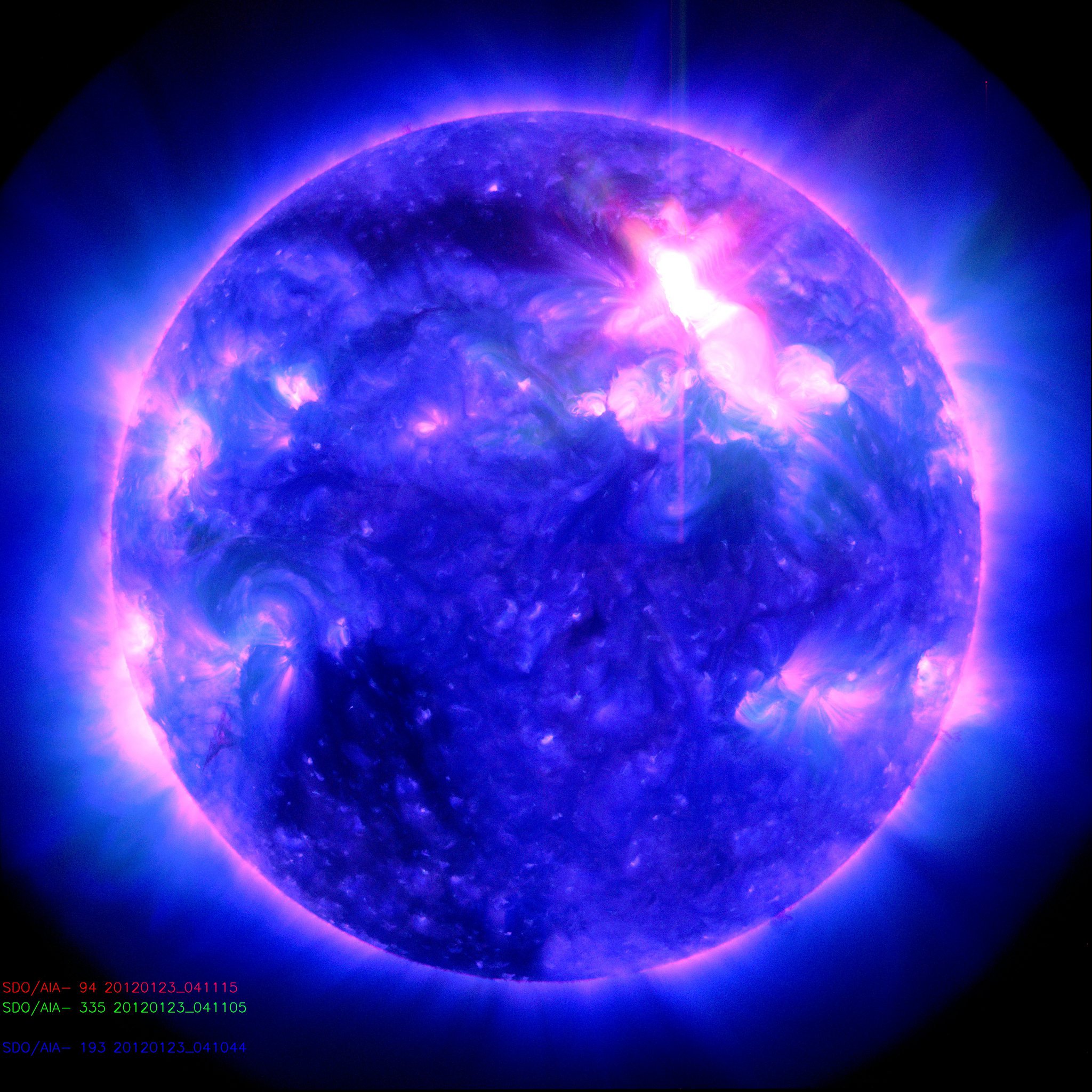
ALMOST-X FLARE AND CME (UPDATED): This morning, Jan. 23rd around 0359 UT, big sunspot 1402 erupted, producing a long-duration M9-class solar flare. The explosion's M9-ranking puts it on the threshold of being an X-flare, the most powerful kind. NASA's Solar Dynamics Observatory captured the flare's extreme ultraviolet flash:


"This was amazing," he says. "It was a wonderful experience to see these stunning auroras."

NOAA forecasters estimate a 10% - 25% chance of continued geomagnetic storms tonight as effects from the CME impact subside. The odds will increase again on Jan. 24-25 as a new CME (from today's M9-clare) approaches Earth. High-latitude sky watchers should remain alert for auroras.
We could experience blackouts, loss of satellite signals, even loss of television (cable) systems.
A powerful solar eruption is expected to blast a stream of charged particles toward Earth tomorrow (Jan. 24), as the strongest radiation storm since 2005 rages on the sun.

Early this morning (0359 GMT Jan. 23, which corresponds to late Sunday, Jan. 22 at 10:59 p.m. EST), NASA's Solar Dynamics Observatory caught an extreme ultraviolet flash from a huge eruption on the sun, according to the skywatching website Spaceweather.com.

According to NOAA, this is the strongest solar radiation storm since May 2005, and as a precaution, polar flights on Earth are expected to be re-routed within the next few hours, Kathy Sullivan, deputy administrator of NOAA, said today at the 92nd annual American Meteorological Society meeting in New Orleans, La.

The solar flare spewed from sunspot 1402, a region of the sun that has become increasingly active lately. Several NASA satellites, including the Solar Dynamics Observatory, the Solar Heliospheric Observatory (SOHO), and the Stereo spacecraft observed the massive sun storm.

A barrage of charged particles triggered by this morning's solar flare is expected to hit Earth tomorrow at around 9 a.m. EST (1400 GMT), according to experts at the Space Weather Prediction Center, a division of the National Oceanic and Atmospheric Administration.

Scientists call these electromagnetic bursts "coronal mass ejections" (CMEs), and they are closely studied because they can produce potentially harmful geomagnetic storms when the charged particles rain down Earth's magnetic field lines.

In addition to generating stronger than normal displays of Earth's auroras (also known as the northern and southern lights), geomagnetic storms aimed directly at our planet can also disrupt satellites in orbit, cause widespread communications interference and damage other electronic infrastructures.

"There is little doubt that the cloud is heading in the general direction of Earth," Spaceweather.com announced in an alert. "A preliminary inspection of SOHO/STEREO imagery suggests that the CME will deliver a strong glancing blow to Earth's magnetic field on Jan. 24-25 as it sails mostly north of our planet."

Sunday's solar flare was rated an M9-class eruption, which placed it just on the verge of being an X-class flare, the most powerful type of solar storm. M-class sun storms are powerful but mid-range, while C-class flares are weaker.

NASA routinely monitors space weather conditions to determine any potential hazards to the astronauts aboard the International Space Station. Based on the agency's assessment, the six spaceflyers currently living and working on the orbiting outpost are not in any danger, said NASA spokesman Kelly Humphries.

"The flight surgeons have reviewed the space weather forecasts for the flare and determined that there are no expected adverse effects or actions required to protect the on-orbit crew," Humphries told SPACE.com in an email.

Finish reading here
The year is 2012 and perhaps the Disaster Gods don't wish to wait until December 21st.

Thursday, January 19, 2012

Earth-Directed Solar Flare Could Bring Geomagnetic Storms This Weekend


Plus a possible disruption of electronics.
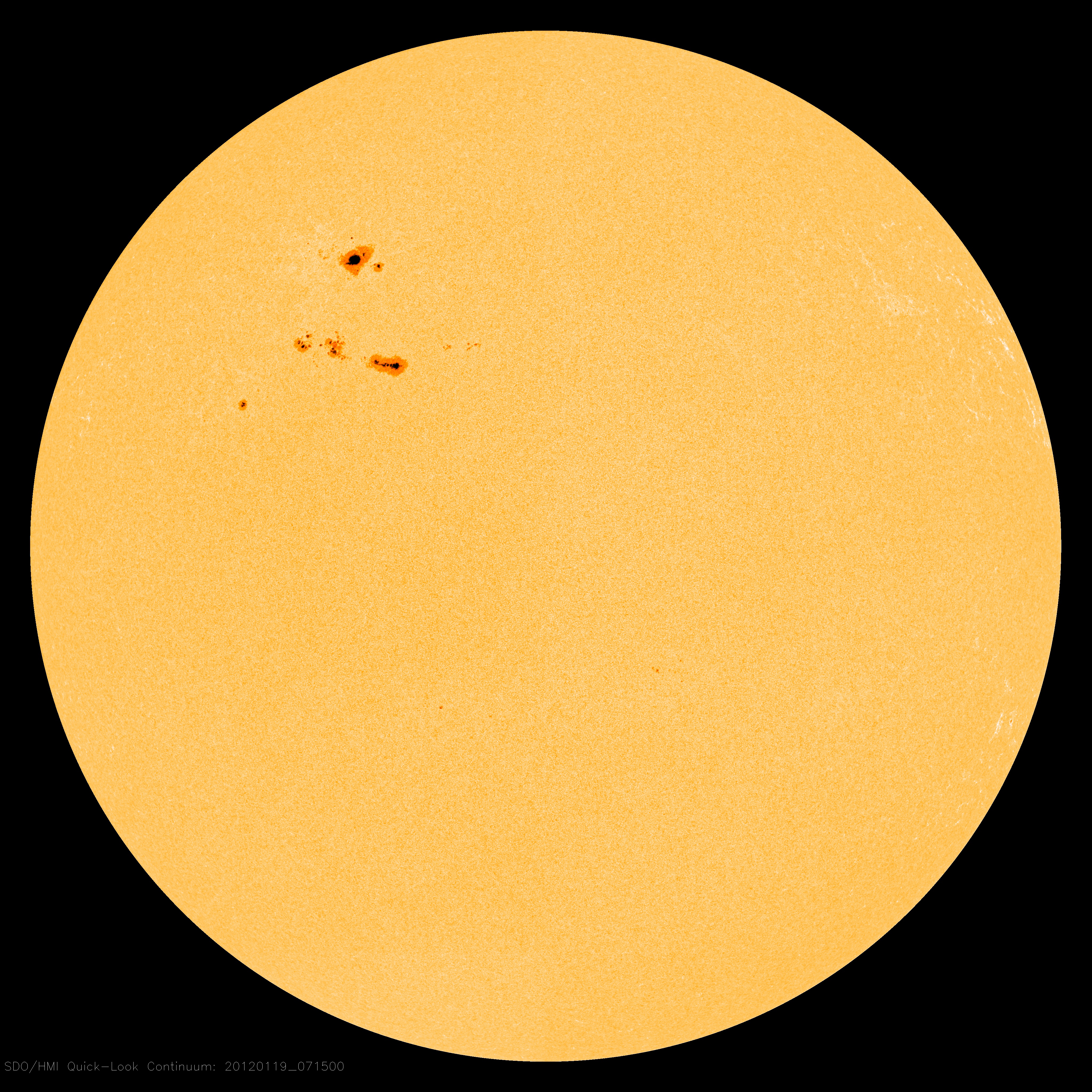
EARTH-DIRECTED FLARE: Active sunspot 1401 erupted today, Jan. 19th, for more than an hour around 16:00 UT. The long-duration blast produced an M3-class solar flare and a CME that appears to be heading toward Earth. Forecasters say strong geomagnetic storms are possible when the cloud arrives during the late hours of Jan. 21st. High-latitude (and possibly middle-latitude) sky watchers should be alert for auroras this weekend.

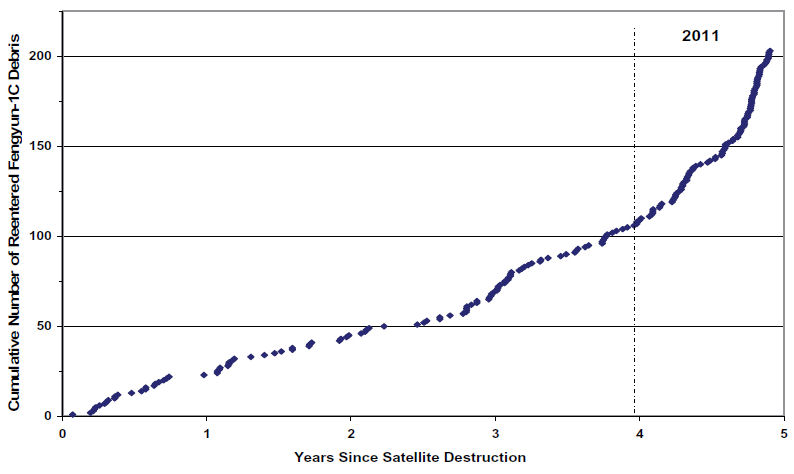
INCREASING SOLAR ACTIVITY CLEANS UP SAT-DEBRIS: Earth's atmosphere has been puffing up in response to increasing levels of UV radiation from sunspots. This is good news for satellite operators, because a puffed up atmosphere helps clean up low-Earth orbit. "The number of cataloged debris in Earth orbit actually decreased during 2011," reports Nick Johnson in NASA's Orbital Debris Quarterly newsletter. "[The figure below] illustrates how the rate of debris reentries from the Fengyun-1C anti-satellite test of January 2007 increased during the past year."


"Even though only 6% of the total 3218 cataloged debris from the ill-advised engagement had reentered by the end of 2011, half of these debris fell out of orbit in the past 12 months," he points out. "Likewise, many debris from the 2009 accidental collision of Cosmos 2251 and Iridium 33 are accelerating their departure from Earth orbit. In the absence of a new major satellite breakup, the overall orbital debris population should continue to decrease during 2012 and 2013."
Discover more about Sunspots, Solar Flares and other Space Weather issues at SpaceWeather.com.

And remember to Keep Watching the Skies!

Thursday, December 29, 2011

Massive Ejaculation!


From SpaceWeather.com:

SOLAR FLARE: Emerging over the sun's southeastern limb, sunspot AR1389 unleashed an M2-class solar flare at 1350 UT on Dec. 29th. The blast shows that the newly-visible sunspot is capable of significant eruptions. AR1389 is not yet facing Earth, but it is turning in our direction.

CHANCE OF MAGNETIC STORMS: NOAA forecasters have downgraded the chances of a geomagnetic storm on Dec. 29th to 20%. A CME is still expected to arrrive later today, but the longer it takes to get here, the weaker its impact is likely to be.

Expect your cell phone, cable tv, even internet to crash.  A solar flare this size can knock out transformers.  (Both Autobots and Decepticons.)  Expect spectacular Auroras from this event.


EARTH-ASTEROID ENCOUNTER:  On January 4th, Asteroid 2011YL28 will be passing within 3.7 LD of Earth.  2011YL28 is 41 m.  LD means "Lunar Distance." 1 LD = 384,401 km, the distance between Earth and the Moon. 1 LD also equals 0.00256 AU. MAG is the visual magnitude of the asteroid on the date of closest approach.
You have been warned.

Saturday, September 24, 2011

Strong Solar Activity Continues


STRONG SOLAR ACTIVITY:  New sunspot 1302 is crackling with strong solar flares.  This morning it unleashed an X2-class flare--its second X-flare in two days--quickly followed by an M7-class eruption.  So far the blasts have not been Earth-directed, but this could change in the days ahead as the sunspot turns toward our planet.  The sunspot is growing and there is no sign that it will quiet down soon.

Go to SpaceWeather.com for more information and pictures.

Tuesday, February 15, 2011

First X-flare of the New Solar Cycle

From SpaceWeather.com:
MAJOR FLARE: Earth-orbiting satellites have detected the strongest solar flare in more than four years. At 0156 UT on Feb. 15th, giant sunspot 1158 unleashed an X2-class eruption. X-flares are the strongest type of x-ray flare, and this is the first such eruption of new Solar Cycle 24. The explosion that produced the flare also sent a solar tsunami rippling through the sun's atmosphere and, more importantly, hurled a coronal mass ejection toward Earth. This raises the possibility of geomagnetic storms in the days ahead. Visit Space Weather for images and updates.

Long-duration M1.0 X-ray Flare August 7 2010 1700-2300 UTC View SDO/AIA