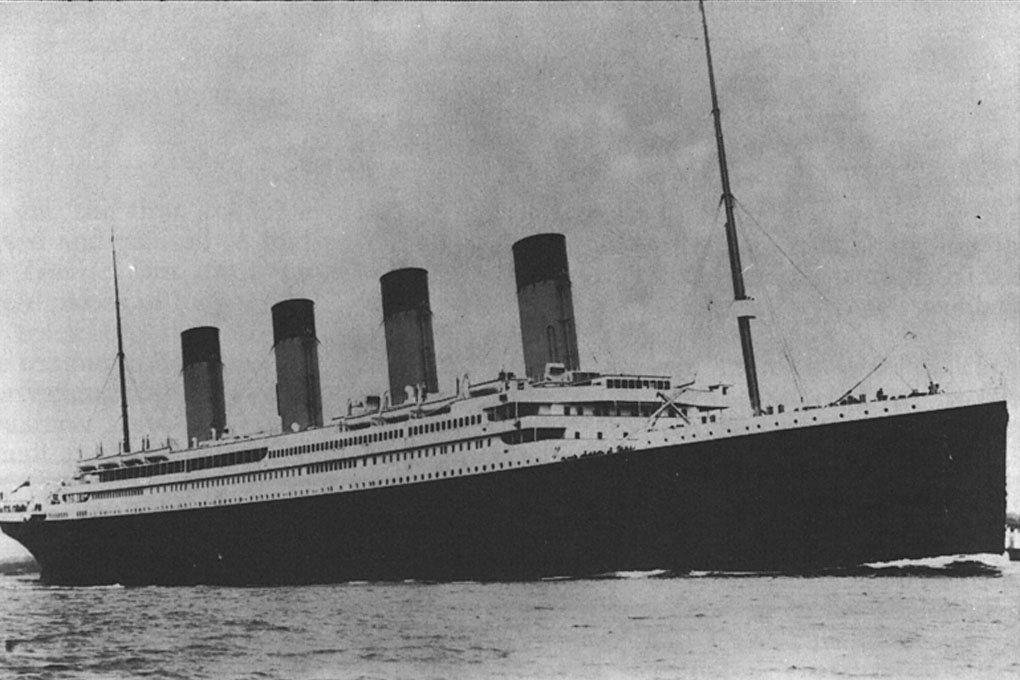
Some Titanic Facts:882' 9" - her length in feet and inches (269.1 metres).
92' - her breadth (28 metres). 175'- the height of the Titanic, from the top of the funnels to the keel (53.3 metres). 900 - the weight of freight and passengers baggage carried aboard, in tonnes. 840 - the total number of staterooms (416 First Class, 162 Standard Class, 262 Third Class). 3,547 - the maximum capacity of the RMS Titanic when fully loaded with passengers and crew. 2,223 - the total number of people on board (passengers and crew). 1,324 - the number of passengers on board. 13 - the number of honeymooning couples on board. 0 - the number of cats taken aboard (cats were commonly taken aboard ships to bring good luck and to control pests. 64 - the number of lifeboats the Titanic was capable of carrying (a total well over the ships maximum capacity of 3547 people). 48 - the number of lifeboats originally
planned for Titanic by the chief designer Alexander Carlisle, 3 on each
davit; the number was reduced to make the decks look less cluttered. 20 - the number of lifeboats actually
carried aboard - 2 x wooden cutters (capacity 40 people each); 14 x 30
ft wooden lifeboats (capacity 65 people each); 4 x folding or
'collapsible' lifeboats (capacity 47 people each). Remarkably, this was
technically legal; the law at that time based the number of lifeboats
required on the gross register tonnage of a ship, not her passenger
capacity. 1,178 - the total capacity, in numbers of people, of the lifeboats carried by the Titanic. 33 - the percentage of the ships total passengers and crew that the lifeboats could accommodate. 6- the number of ice warnings the Titanic received before the collision. 22.5- the ship's speed in knots whilst traveling amid iceberg laden waters, just .5 knots below the top speed of 23 knots. 30 seconds - the length of time between the first sighting of the iceberg to the impact. 4 - the number of forward compartments that could flood without risk of the Titanic sinking. 6 - the number of forward compartments that were ruptured in the collision. 5mm- the minimum amount of movement of
the hull's steel plates before the wrought iron rivets used in her
curved sections would fail. Due to access difficulties in using a
pneumatic riveting machine to construct the curved sections of the hull,
these steel plates were sealed using wrought iron rivets rather than
the stronger steel rivets used elsewhere; iron rivets were easier to
hammer into place. As shipbuilding moved to using steel instead of iron
plates in the construction of hulls, this practice was widespread.
However, forensic tests undertaken in 1996 by Johns Hopkins University
in Baltimore revealed that, in the case of the Titanic, these iron
rivets would fail with just a 5mm movement of the steel plates they were meant to secure.
It took the Titanic 2 hours 7 minutes to sink. Only 15 minutes to hit the floor of the ocean. The water temperature was 28.4 degrees F (-2 degrees C). This meant that a swimmer would survive 15 to 45 minutes.


No comments:
Post a Comment